Saturday, July 23, 2011

Snow King Hill Climb Run 2011

Snow King Hill Climb 2011

Jackson Hole and the Tetons on an early morning training run from top of Snow King
                                                                       
The 44th annual Snow King Hill Climb was today Saturday, July 23rd.  The race is a longstanding event that has tested the guts of many athletes, runners, hikers, tourists, and visitors that come just for the race.
Snow King I believe is the third ski resort to open to skiers in the United States. Sun Valley, Idaho was the first in 1936. In Utah, Alta quickly followed suit in 1938. Snow King was next in 1939. Snow King is Jackson Hole’s in town ski area. The opening of a rope tow at Snow King in 1939 marked the first ski area in Wyoming. In 1946 Snow King added a chairlift that took skiers to the top of the mountain. A lift ticket cost $2.95 for a full day of skiing.

Looking up from bottom of Snow King
It was nineteen years later that the Jackson Hole Mountain Resort opened in 1965. The aerial tram was operating by 1966 to the top of Peak 10,450.
The Snow King Hill Climb attracted 101 racers or Hill Climbers. A great turn out for a very tough event. The running race is part of the 2011 Run to the Summit Series which includes 3 area Hill Climb races culminating in 12 miles and over 7,500 feet of elevation gain. All three Hill Climb events are at the local ski resorts – Grand Targhee, Snow King, and JHMR’s Rendezvous Mountain Hill Climb.
Looking down towards bottom of Snow King and Town Square from near top
                                                                   
Today’s race started at 9 a.m.under perfect Wyoming blue skies. It was the second race of the three part series. I had placed 4th at Grand Targhees’ Wrun for Wray on June 25th. I decided to try a new tactic for my own race today. I have always been inspired by Steve Prefontaine and his incredible talent and guts. I was reaching a bit for extra motivation when I found a new quote of his; it quickly became my motto for the day. “The best pace is a suicide pace and today’s a good day to die”. It fit perfect for me. Steve Prefontaine was a “front-runner” and liked to give it his all from the very start of a race. Not wanting to wait for the race to unfold, but to give it all he had from the start. I was game to try this exact theory. I have many times not gone out full tilt watching and letting others break wind. Today it was my turn to try.

Steep Switchbacks

Loose terrain and steep
                          
approached and quickly runners took the front line spots. I was a bit tardy on line up as I was talking with friends from out of town. But, I got up to the third row. The gun sounded and the shoes were kicking and flying through the air. After 20-30 seconds I was in about 6th place, it wasn’t all my effort as I had promised myself. I looked for an opening and quickly was behind the leader, again I had more to give and took off into the lead and stretched it far enough that I couldn’t hear the others behind me. I looked back over my shoulder and saw the attackers staring me down. I held on for the ½ mile sprint to the bottom of the steepness. Quickly, a few runners went by me as I was in oxygen debt. I stayed focused and kept after the climb. A few more runners went by before the first switchback. From this point on only one runner passed me and I swapped places with another on the entire climb. The top finisher was fast and was only a second from the 44 year record. I was pleased with my effort and my tactics, I tried to be Pre, and was honored to have “front-run” for part of the race. I finished in 10th place out of the 101 entries and was fairly happy with my time and results. I had run the course faster earlier in the week, but that is racing, you take what you give on race day and don’t complain, at least that’s my theory. The top guns deserve credit for their incredible performance.
Chris Kroger, Pete Swenson, Jaime Falcon

Top 10
                                                                                                                   
Partial Results 2011 Snow King Hill Climb


Thursday, June 23, 2011

South Teton Summer Surfing - Skiing

South Teton Summer Surfing – Skiing June 22, 2011

The Teton range from summit of South Teton
                                                                               
The summer solstice greeted us June 21, 2011 and with the Solstice came the sunshine. I believe I read in the local Jackson Hole paper that the average temperature in May was 46 degrees. The early part of June followed the same weather pattern – a lot of clouds and rain with not much sunshine. This weather has helped the snow pack remain intact in the high country of the Tetons and other local mountain ranges.
                                                                             
The alarm was set for and I woke about 15 minutes before the chime sounded. I looked out the window and walked outside to check the weather and get a feel for the temperature in the darkness. It was cold enough and the skies were clear for a summit attempt and ski. With the longest day of the year being two days ago, I knew the sun would be rising early over the Gros Ventre range and spreading warmth on the peaks of the Tetons.
Morning light over Jacksons' valley of green
                                                                          
I knew the day could be a long one, so I ate a big breakfast and made a cup of coffee for the 25 mile drive to the trailhead in Grand Teton National Park. Driving north to Lupine Meadows, the usual characters were mulling around in the darkness – Elk. As I entered the Park, I tried to sneak a look at my objective in the mountains, but the abundance of elk just off the side of the road had my attention. Elk cows weigh from 450 – 600 pounds while the bulls weigh in at 800 – 1,000 pounds. I always enjoy seeing them early in the morning and focused not to take my eye off of the road.

Ice Cream Cone and South Teton


Upper Garnet Canyon


I started into Garnet Canyon solo. I had called one friend the day before to see if he was interested in joining me, but found out he was in Colorado guiding. I moved at a steady pace and soon saw evidence of people ahead of me. Fresh foot prints in the trail and wet rocks assured me there were people ahead of me. As I reached the Meadows of Garnet Canyon I saw 3 separate groups of skiers. Two groups were already heading up the South fork, the direction I was headed. The other group watched as I approached quickly. A friendly voice asked a few questions and asked my name – we had crossed paths ski mountaineering before and he is a well known strong ski mountaineer. He was leading a group up towards the Lower Saddle in Garnet north fork. We agreed it should be a nice day and we set off in different directions at the canyon fork. I pushed the pace up a little to see if I could catch the others ahead of me. After an hour, I had made contact and we exchanged greetings, then I was skinning out ahead, but I was tired. I arrived on the summit of the South Teton a few minutes after alone. There are three peaks that are central to the range – The Grand Teton, Middle Teton, and South Teton. This was my 51st summit between the three of them and the 15th  summit of the South Teton.
South Tetons' East Ridge (on Right) and corn skiing below
                                                                                
The views from the top were spectacular. The views towards the valley 6,000 feet below showed a wild Snake River approaching high water levels. The valley was green and the peaks across the range were still well covered with snow. Looking towards the West I could see far across Idaho. I soaked in the views for awhile as I prepared for a summer ski from the summit. I choose to ski the East Ridge off the summit towards the Ice Cream Cone notch. The ski off the summit is steep and I was focused on my skiing. After reaching the col between the South Teton and the Ice Cream Cone the steepness backed off and I continued on down the north glacier. The ski off the summit of the fifth highest peak in the Tetons was another great day in the mountains.
                                                                                        

Sunday, June 5, 2011

Sun Valley 1/2 Marathon


Sun Valley Half Marathon
Ketchum, Idaho  June 4, 2011
                                                                                
                                                                             
A look at my 2011 calendar kept reminding me that the Sun Valley Half Marathon was approaching fast. I had never run a half marathon, marathon, or long road run for a race. I prefer the trail runs or mountain hill climbs. I rarely run on the road, but do occasional runs on the local bike path to time accurate mileage. Otherwise, I prefer the softer grounds of trails, dirt, or grass assuming a level route.
Race Start/Finish
I had participated in a ski race event a week earlier and was now going to try a running race. The joys of spring offer a multitude of outdoor adventures in which to consume. It is certainly the time of year to mix your sports. I have been skiing, biking, and some running. A friend of mine was going to the race and said there was room in the car. I signed up a few days before the race, studied the course, and took the spot in the car. It looked like a fun race – a quick trip to Sun Valley, my first half marathon, no great expectations for a podium, and scenic location.
                                                                           
I had spent a short time preparing for this race with a few small and moderate size runs. I was mainly relying on strength from ski season. So, I knew it was going to offer new muscle groups a challenge. I had no real plans for a strategy except, ‘run a good race’. I knew there were ‘runners’ here and I was entering as a ‘ski mountaineer’. The race Start is at approximately 5,920 feet. The race course involved two small hill climbs, some rolling terrain, and a few straight sections.
                                              
Race Start, evening before race


Bald Mountain and Final Mile


Sun Valley is home to the world’s first chairlifts which were installed in 1936. Sun Valley is also home to Olympic Gold medalist Picabo Street. Bald Mountain looms over the Wood River Valley with snow and ski runs still very prevalent.
Race day dawned perfect and the start was great and allowed for plenty of time to prepare final adjustments. The pavilion at Sun Valley was full of smiles, runners, sunshine and people ready to race. The gun sounded and a new race had begun. I finished the course in a time of which was good enough for ninth place overall. I had a great visit to Sun Valley and hope to explore more of the surrounding trails and peaks in the near future.

Division award and Hydration

Relaxing after race


Wednesday, June 1, 2011

Ski to Sea

Ski to Sea 2011
 Sunday May 29th, 2011  Mt. Baker to Bellingham, Washington

Kayak salad


One hundred years ago, 14 brave souls threw caution to the wind, braved snowstorms, and risked their lives to compete in what has been labeled the first endurance race in American history – the Mount Baker Marathon.

Mt. Shuksan from Mt. Baker ski start area

The marathon lasted from 1911 – 1913 and was the forerunner to today’s Ski to Sea.
The original competitors choose either automobile or train to access the base of Mt. Baker. The 116 mile race of mud, snow, sweat, and glory was short lived due to numerous hazards. Two different routes to the summit were viable. The races’ only rules were to start from Bellingham, Washington and summit 10,781 foot Mt. Baker and finish back in Bellingham. The competition consisted of loggers, coal miners, farmers, students, postman, and attracted a few professional marathoner runners and Olympians. The 1911 race was won by Joe Galbraith. In 1911 a U.S. postage stamp was 2 cents, the Median U.S. Income was $983 per year (U.S. Census Bureau) and the average price of gasoline of gas was 25 cents. It would be 60 years before the spirit of the Mt. Baker Marathon would be resurrected to the event that is known today as the Ski to Sea.

Max Taam, Jordan Hart, Me

Runners take 3rd leg down Mt.
                               

 In 1973 Ski to Sea had fifty-two teams enter for a new relay race featuring downhill skiing, biking, and canoeing. The 2011 race has 7 different legs and is 100 miles in length. The race consists of an uphill/downhill alpine ski, cross country ski, run, bike, canoe, mt. bike, and kayak leg. The race is capped at 500 teams which quickly calculate to 3,500 racers.
I received a phone call one afternoon and was asked by Tony Velasco to join a Team in the Ski to Sea. I accepted the fully sponsored trip. The trip to Bellingham enabled me to enjoy a great event while meeting many super athletes and catch up with some ski mountaineering friends. I knew that Max Taam was going and heard rumors of Greg Ruckman and Brandon French attending – all great athletes. It looked like good fun, the price was right, and I was able to get another ski mountaineering race in for the year.


keep moving or the Moss might start growing on you


Both Max Taam and I were among athletes staying in a cabin arranged by our Team Captain Tony Velasco near the base of Mt. Baker. Max was on the Boss Construction 1 Team and I was on R.B. Wick’s Masters Gentlemen Team. Gulp, it was my first Master’s event. The team I (Alpine Ski Uphill/DH) was on consisted of Chris Humbert (XC Ski), Shaun Marshall-Pryde (Run), Aaron M. Berntson (Bike), Darryl Spencer and Tinh Vu (Canoe), Todd Gallaher (Mt. Bike) and Kirk Christensen (Kayak).

R.B.Wick, Aaron Berntson, Me, Kirk Christensen, Chris Humbert, Shaun Marshall-Pride

                
The racing resumes of these athletes were off the charts. I was amongst people of great passion, talent, and inspiration. I was honored to join these ‘Gentlemen’. I met many great people including Jordan Hart and R.B.Wick. The Ski to Sea was a great race to participate in and then cheer on my own team-mates as they race off the mountain of snow and down to the waters of Bellingham. The Overall race wining time was 6 hours 11minutes and 22seconds. Our team finished 10th overall out of 500 teams in .

For results www.skitosea.com

Sunday, May 22, 2011

The Jaw, Mt. Woodring

Grand Teton National Park   May 15-21, 2011

The Jaw 11,400
As the daylight continues to get longer each day I remind myself that the longest day of the year is a month away. With that in mind and the snow still in the mountains, I made two trips this week into GTNP for ski tours. Though the days are getting longer, clouds have been dominating the skies for much of the week diluting the ‘long days’ by filtering out the sun.
I set out for The Jaw. The Jaw tops out at 11,400 feet at the head of hanging canyon. The ascent is just over 4,500 feet. I had been to the summit once before, also a ski descent, on May 5, 2002. I know Hanging Canyon well from summer hikes, climbs, and visits to the Lake of the Crags. The lake sits near 9,600 feet and is surrounded by spires, peaks, crags, and pinnacles hidden in the Hanging canyon.

Skin track above Jenny Lake headed into Hanging Canyon
Driving from home, I noticed blotches of wet road the further north I traveled. The temperature outside was 28 degrees. Arriving, I was surprised and happy to find myself the only patron there. I geared up and the weather was cooperating nicely and showing signs of sun. I turned and jumped up on the snow bank and skinned over to the bridge. The bridge showed a trace of new snow and confirmed no one had been across yet. With good snow coverage, I quickly traversed up and into Hanging Canyon. A trace of new snow nicely outlined the skin track and views of Jenny Lake were amazing. Jenny Lake’s ice was breaking up and it looked like the surface had craters or a glass pane shot full of bullet holes. I skinned uphill at a steady rate so I could be skiing before any weather or warm-up may occur. The forecast was for a 30-40% chance of precipitation. I took my La Sportiva race skis anticipating fast travel conditions. The skis were fast on the approach. I took a break at the entrance to the hanging canyon to eat and hydrate a bit more. The weather was holding and I had a great view of The Jaw, Lake of the Crags, and Jenny Lake.

Final steps to summit of The Jaw
Turning for the summit, the next section was great as I skied across the smooth frozen lakes. Striding, poling, and gliding, I was eyeballing the summit and the final 1,800 feet to the top. After another 1,000 vertical feet of skinning I transitioned to a boot pack. The route took you straight up the east face through some small cliffs and rock features. As I approached the steepest section the clouds came in quickly and enveloped me.
The Grand Teton

I slowed assuming they would move on or out and eventually they did. The clouds soon became the show to watch as they displayed magical properties. I arrived at the summit amongst floating and hanging clouds back lit by the sun. I soaked up the views of the clouds in motion, the Grand Teton, and the interior range. I stood on the summit, watching the clouds dance above and below. I clicked in my skis ready for my own dance down the mountain.
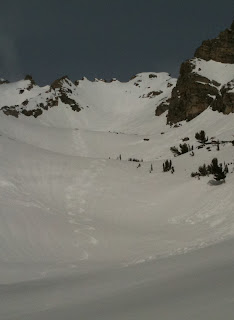
Skiing down
Hanging canyon


Lake of the Crags


                               Mt. Woodring 11,590

Mt. Woodring's South face, on right, as seen from the top of The Jaw

I spotted the summit of Mt.Woodring from The Jaw and it looked to have good coverage and a nice ski decent. I have been to the summit of Mt. Woodring twice, and skied the south face once. Paintbrush Canyon has many options for ski lines, peaks, and couloirs with Mt. Woodring at the head. I sipped the last bit of coffee in the car and set out under almost complete gray skies. The initial few miles of the approach is low elevation and heavily forested. I skinned undulating snow along String Lake to the bridge crossing. I made haste to get out of the woods and into Paintbrush Canyon where the vistas would improve if the weather held. The trees started to spread out and I entered the canyon. Ski lines were now visible with more options up canyon and the gray skies held their ground. However, ski conditions improved as I gained elevation. The snow was firm and smooth and travel was easy.  I, again, had chosen to use a light race set up – the La Sportiva race skis. Further up canyon, old avalanche debris had run from all aspects.

I turned the corner and attained the south face of Mt. Woodring. I was 2,200 feet directly below the summit. The weather was holding up well and glimpses of sunlight on distant peaks were promising.
However, I had begun to enjoy the black and white landscape and couldn’t help but think of Ansel Adams and his photographs of Yosemite and the High Sierra. Ansel Adams’ first solo museum exhibition was at the Smithsonian Institution and featured pictures of the High Sierra. A review from the Washington Post stated, “His photographs are like portraits of the giant peaks, which seem to be inhabited by mythical gods.”
I skinned up the south face for another 1,200 feet before transitioning to crampons and an ice axe for the summit climb. The views from the top were spectacular, highlighting the black and white contrasts of the mountains, snow, shadow, and sun.

Looking down fron the summit of Mt. Woodring across Paintbrush Canyon and the Tetons
There were a few options for ski descents from the summit. I quickly decided to go with the south face, the way I ascended. I took in the sights, slipped into my bindings, and skied off the summit towards Paintbrush canyon. The ski descent was approximately 4,700 feet of firm smooth conditions at the higher elevations, good corn skiing mid canyon, and heavier snow heading out.

Steep section near top
String Lake


Monday, May 16, 2011

Test Ski

Spring Skiing – La Sportiva Race Ski 717 grams !

May, is the fifth month of the year on the Gregorian calendar. May is also known as ‘the springtime of life”. In some countries, it is the month ‘to honor labor.’ Well, it sure sounds like a good month for ski mountaineering – Springtime of Life and Labor. Long days and shadows coupled with warm temperatures have changed the look of the landscape. The once all white landscape of winter has transformed to a deep snow pack in the high alpine and the green of spring reigns in the valley below and the alpine trees soak in the sun.
               Early starts are required for ski touring now if the sun is forecasted for ski day. One can occasionally get away with a later start if cooler weather or wind hold temps down. Animals are migrating and breaking out into the warm sunny meadows. Moose and Elk post hole around the lower elevations in the melting snow and tributaries are gushing water.
                                                                           
If this sounds like spring, it has arrived here in Jackson Hole, Wyoming. The storm track remained pointed at Wyoming in April and we continued to add to our already solid snow pack. With the ski mountaineering racing season coming to a close at the end of April in Colorado ( a great year it was..), my eyes now look to the mountains for long days of ski touring and ski mountaineering.
I received a pair of La Sportiva race skis in April and was asked to test the strength of the ski. The prototype ski weighs in at 717 grams. The ski has structure mechanics including carbon, wood, and a new technology from the factory. I was super psyched to be on the new race ski by La Sportiva.
The ski arrived with a top sheet cosmetically ‘white’. No graphics. So, it creates a lot of attention, double takes, and questions. They look stealthy. I put a pair of race bindings on them and was off to the mountains. I have used them in the backcountry and let them fly at 2 skimo races since April. After nine days of testing the skis I have found no major weakness. I have intentionally skied them hard, but not trying to break them. The skis have predominantly been taking in the spring snow conditions which include: firm snow, unforgiving undulations, some lower elevation bush whacking, breakable crust, wet snow and other surprises. Sounds bad, but the skiing has been really good. The skis have performed well and I will continue to test the La Sportiva skis. I have been using these skis regularly in the backcountry the last month. A few pictures capture the various terrain and the joy of spring skiing.

                           
However, nine days of skiing in the last month is a major drop from the every day skiing of winter. But, I am well aware the ski season if far from over. The ski mountaineering season begins for this racer and I look forward to ski touring, peak bagging, corn, couloirs, sunrises in the alpine, and big open descents for many weeks to come. 

The couloir we skied was from the summit and goes from L-R behind the ridge
The La Sportiva prototype skis dropping in the shady side of things...


Wednesday, April 27, 2011

San Juan Ski Mountaineering Race

                                                                                
A cirque of couloirs to ascend and descend

This past Saturday on April 23rd high in the San Juan Mountains in Colorado ski mountaineers turned out for race day. This ski mountaineering race, unlike many others, was a race held completely in the backcountry. The course looked like a good one. There were many steep couloirs and steep terrain in which to negotiate. It was also a high elevation race, as the course was to start near Molas Pass at an elevation of 10,700 feet. Racers planned to top out over 13,000 feet on Spencer Peak before the final descent.
                                                     

It was my first visit to the area in winter, so I quickly drove up to Molas Pass the day before and tried to view the course from the highway. I had a new pair of “white skis” that I wanted to test out before the race the following day. So, I skinned up casually to the cirque below the couloirs we planned to travel through during the race. The skis and bindings were probably the lightest set-up on course.

new race set up and lower regions of race course


Race morning dawned and the weather seemed to be holding up well, as the forecast called for weather approaching by mid-day. As we drove to the start, slowly the weather was approaching, but still good for a start. At the start Scott Simmons bolted to the front, with Marshall Thompson, Pete Swenson and I on the chase. The course was firm and technical. As we climbed higher the clouds were dropping to meet us. Quickly, it was becoming hard to see anything, the storm had begun. We made one ascent with a boot-pack and skied a nice couloir into the white-out cirque below. I skied to my left and saw Scott, Pete, and Marshall heading up the next climb. I skied down to the transition area and quickly was skinning back up the slope to the next boot pack. I transitioned to the boot pack and started up the kicker, I could see Marshall not far in front of me now – finally I could see something besides white. Then I saw two shadows and then skiers emerge from the storm to greet Marshall and then me. USSMA director and racer Pete Swenson and Durango local Scott Simmons decided to halt the race due to storm conditions and poor visibility, making safety first. It was definitely the right call as the course had become a blizzard. We accounted for all the racers and a few of us decided to climb and ski one more couloir before meeting with the others. Of course we all wanted to finish the race, but Mother Nature and safety decisions forced a stop to the race.

                                                    
At the start/finish we all gathered around and met our fellow friends and ski mountaineers. We reacquainted, renewed, and added friends at another ski mountaineering race. A big part of racing is the friendships you make and build along the way, and of course the adventures that follow. The San Juan Ski Mountaineering race will be grand next year and hope to see you all there for great skiing and great times.

 
U.S. Ski Mountaineering Team members at San Juan race: Pete Swenson, Chris Kroger, Janelle Smiley, Scott Simmons